
Key Insights
- CARB states follow California’s vehicle emissions standards, which are generally stricter than federal EPA requirements.
- Congress revoked three major California emissions waivers in 2025, while California repealed key private fleet requirements under Advanced Clean Fleets in 2026.
- California’s Clean Truck Check still applies to most heavy-duty vehicles over 14,000 lbs GVWR operating in the state, including out-of-state trucks.
- Fleets must register applicable vehicles, pay annual compliance fees, and complete periodic emissions testing to avoid penalties and registration issues.
Few compliance topics confuse fleet managers more right now than CARB states. Headlines say California’s rules are being rolled back, yet out-of-state trucks are still expected to pass periodic inspections once they start hauling freight in California. Both things are true, and the gap between them is exactly where fleets get caught off guard.
These states have adopted California’s stricter emission standards in place of the federal ones. For years, that list was easy to track. Then the last two years brought revoked waivers, lawsuits, repealed fleet rules, and a federal court injunction, which left many guides on this topic quietly out of date.
This guide covers what these states are, how CARB vs EPA rules differ, which states follow California today, what changed recently, and what the state still expects from your trucks right now.
What Are CARB States?
They are U.S. states that follow the vehicle pollution rules written by the California Air Resources Board rather than federal rules alone. Section 177 of the Clean Air Act makes this possible, but only if a state copies California’s rules exactly, which is why you’ll also hear them called Section 177 states.
The California Air Resources Board was created in the 1960s to fight the smog that had settled over Los Angeles. Federal law generally prevents states from writing their own vehicle pollution rules. California is the one exception, because federal regulators can grant it a waiver to enforce rules tougher than the national version.
Other states can then piggyback on that waiver. Under Section 177 of the Clean Air Act, a state’s standards must match California’s, and both states must finalize the rules at least two years before the model year they take effect. The identical-copy requirement prevents a “third vehicle” problem, so every state chooses between two versions: federal or Californian.
That choice carries real weight. Together, the states following California make up roughly 40% of the U.S. new-car market, so California’s rules shape what manufacturers build nationwide.
What’s the Difference Between EPA and CARB?
The Environmental Protection Agency is the federal agency that sets nationwide vehicle pollution rules under the Clean Air Act.
The California Air Resources Board is a state agency with special permission to set its own, usually tougher, rules. Other states can follow either version for new vehicles, but they can’t mix the two.
For passenger vehicles, the gap has narrowed over time. DieselNet notes that California’s standards have historically been tougher, but the latest federal and California tiers moved closer together. For fleets, the bigger differences now show up in certification and in enforcement on the road.
| Topic | Environmental Protection Agency | California Air Resources Board |
|---|---|---|
| Who it is | Federal agency | California state agency |
| Where its rules apply | All 50 states by default | California, plus states that adopt its rules |
| Aftermarket engine parts | Largely manufacturer self-certification | Tested and approved with an Executive Order (EO) number |
| Heavy-duty truck inspections | No national periodic program | Clean Truck Check for trucks operating in California |
The parts difference is worth knowing. According to SEMA, federal rules rely on manufacturers to self-certify that a pollution-related part is street legal, while California requires evidence before it issues an EO.
So when the question is “EPA or CARB?”, the California path is usually harder to clear and easier to prove.
Which States Follow California’s Standards?
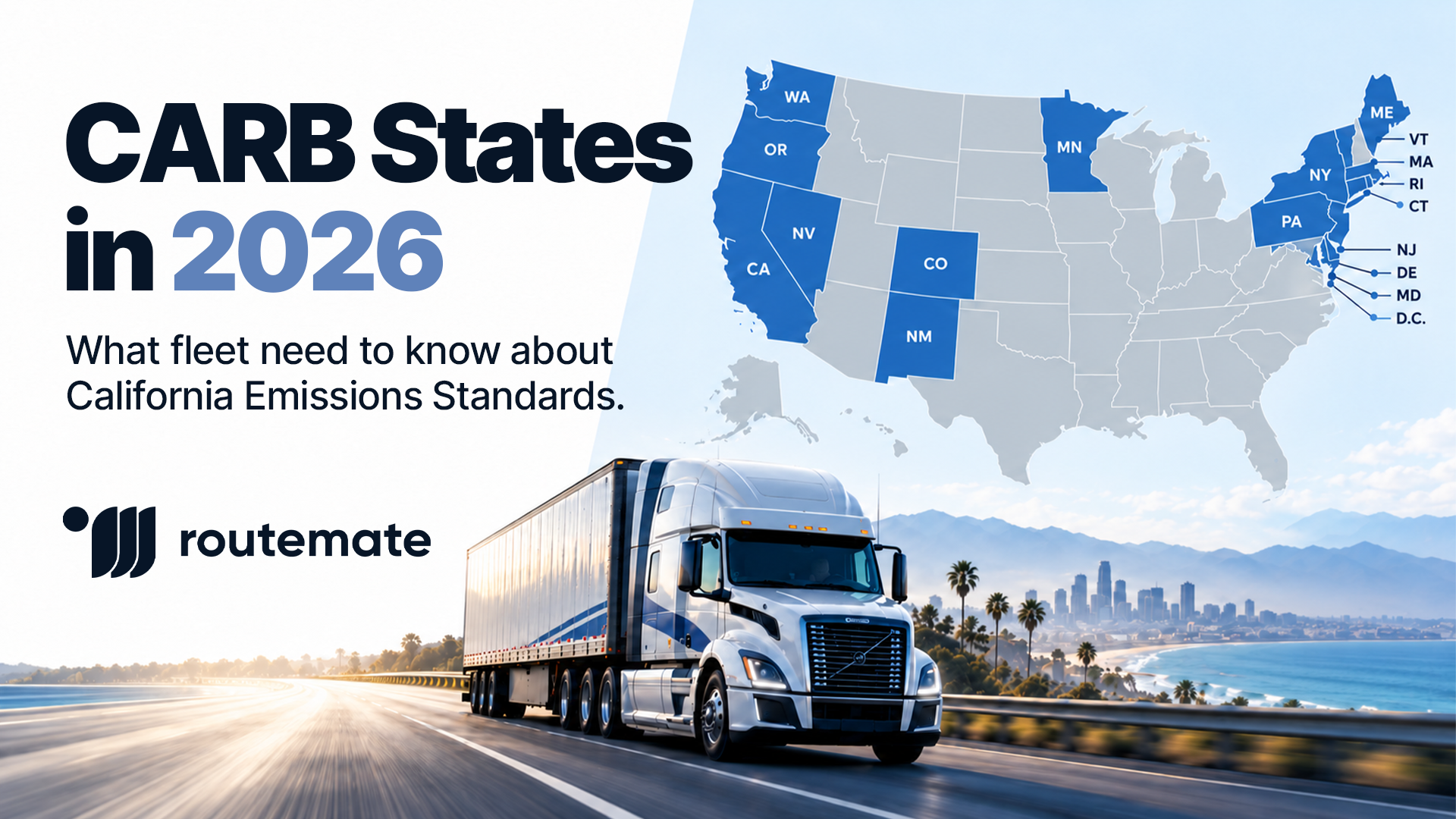
As of 2026, the states with California emissions standards are California, Colorado, Connecticut, Delaware, Maine, Maryland, Massachusetts, Minnesota, Nevada, New Jersey, New Mexico, New York, Oregon, Pennsylvania, Rhode Island, Vermont, and Washington, plus Washington, D.C. Pennsylvania follows only the tailpipe standards for conventional engines.
Not every state adopts the same pieces. The LEV rules cover smog and greenhouse gases from conventional engines, the zero emission vehicle (ZEV) program sets electric sales targets for automakers, and Advanced Clean Trucks (ACT) applied similar targets to commercial trucks. Here’s how the carb-compliant states line up, based on Alternative Fuels Data Center adoption records:
| State | LEV standards | ZEV program | ACT (trucks) adopted |
|---|---|---|---|
| California | Yes | Yes | Yes |
| Colorado | Yes | Yes | Yes |
| Connecticut | Yes | Yes | No |
| Delaware | Yes | Yes | No |
| District of Columbia | Yes | Yes | No |
| Maine | Yes | Yes | No |
| Maryland | Yes | Yes | Yes |
| Massachusetts | Yes | Yes | Yes |
| Minnesota | Yes | Yes | No |
| Nevada | Yes | Yes | No |
| New Jersey | Yes | Yes | Yes |
| New Mexico | Yes | Yes | Yes |
| New York | Yes | Yes | Yes |
| Oregon | Yes | Yes | Yes |
| Pennsylvania | Yes | No | No |
| Rhode Island | Yes | Yes | Yes |
| Vermont | Yes | Yes | Yes |
| Washington | Yes | Yes | Yes |
Keep in mind that “adopted” no longer guarantees “enforceable.” Congress revoked the ACT waiver (more on that below), so the truck column reflects what states put on the books, not what they can currently require.
ZEV States and What Changed
ZEV states are the states that adopted California’s electric vehicle sales program. The program targets manufacturers, not buyers: it sets the share of electric vehicles automakers must deliver for sale, and buying or registering a used gas vehicle is unaffected. The most aggressive version, Advanced Clean Cars II, would have required 100% electric sales by 2035, but Congress revoked its waiver.
States That Left or Paused
Membership has shifted before. Virginia withdrew from the electric vehicle mandate and reverted to federal standards. Further back, Arizona adopted California’s standards in 2008 and repealed them in 2012. On the truck side, Maryland, Massachusetts, Oregon, and Vermont delayed their truck sales requirements as federal pushback gained momentum.
What Changed in 2025 and 2026
The last two years reshaped emissions regulations across these states more than any period in the program’s history. Here’s what happened, in the order it matters to fleets.
Congress Revoked Three Major Waivers
On June 12, 2025, Congress signed three Congressional Review Act resolutions into law, revoking the waivers for Advanced Clean Cars II, Advanced Clean Trucks, and the Omnibus Low NOx rule.
ACT would have required rising sales of electric Class 2b through Class 8 trucks, and Omnibus would have required a further 90% cut in NOx from heavy-duty engines.
Because Section 177 states rely entirely on California’s waiver, their copies of these rules lost their legal footing too. The move remains contested: the Government Accountability Office had concluded that these waivers are not rules subject to the Congressional Review Act, and California and a coalition of 10 other states sued the same day the resolutions were signed.
Older Waivers Came Under Fire, and a Court Stepped In
In June 2026, federal regulators reclassified several older California waivers as “rules”. They resubmitted them to Congress, including the 2013 waiver for Advanced Clean Cars I, which is mostly a smog rule with a small electric vehicle component.
On September 2, 2026, a federal judge in Washington, D.C. granted California a preliminary injunction blocking that reclassification. For now, the baseline rules most of these states rely on remain in place, though the legal fight is far from over.
Advanced Clean Fleets Is Mostly Gone
California also stepped back. The state’s repeal of the High Priority and Drayage Fleet requirements under Advanced Clean Fleets took effect on September 10, 2026. Private fleets no longer face a state mandate to buy electric trucks, while requirements for state and local government fleets remain.
What Does CARB Compliant Mean?
Being compliant means a vehicle, engine, or part meets California’s clean air rules and is legal to sell or use in California and the states that follow it.
For new vehicles, that shows on the engine certification label. For aftermarket parts that affect tailpipe output, it means the state has issued an Executive Order (EO) number.
The EO is the piece fleets run into most. When a part passes the state’s evaluation, it receives an EO number that appears on the part, its packaging, and its marketing.
If federal investigators ever question a part, that EO number is also the first thing they’ll ask to see, so it covers you nationally too.
Parts without an EO that aren’t direct replacements for original equipment are a different story. Manufacturers routinely label them for closed-course racing use only, which means installing them on a highway truck creates real exposure under state emission laws.
Before your shop installs a tuner, intake, or exhaust component on a truck that runs in California, confirming the EO number is a five-minute check that can save you a failed inspection.
The Rule Your Fleet Still Has to Follow: Clean Truck Check
While most coverage focused on revoked waivers, California’s heavy-duty inspection and maintenance program kept moving forward.
Clean Truck Check applies to most diesel and alternative-fuel vehicles over 14,000 lbs GVWR operating on California roads, including many out-of-state trucks.
That out-of-state piece caused confusion in early 2026. Federal regulators disapproved part of California’s air quality plan related to the program.
Still, the state clarified that this only stops it from counting pollution cuts from out-of-state trucks toward federal air quality goals, and the rules still apply to every vehicle operating in California.
The state’s focus here is easy to understand: out-of-state and out-of-country trucks make up about half of the heavy-duty vehicles traveling in California and roughly 30% of heavy-duty NOx output. That’s a large share of the air pollution the program was built to address.
What Compliance Involves
For most fleets, Clean Truck Check comes down to four recurring tasks:
- Report each vehicle in the state’s Clean Truck Check Vehicle Inspection System (CTC-VIS).
- Pay the annual compliance fee, which is $32.13 per vehicle for 2026.
- Complete emission testing through a state-credentialed tester, twice a year for most vehicles.
- Submit passing results before each deadline. Passing tests are accepted up to 90 days early.
What Happens If You Skip It
The consequences build on each other. Noncompliance can escalate to DMV registration blocks, and testing frequency doubles to quarterly for OBD-equipped trucks starting in October 2027.
Trucks that only visit California occasionally may qualify for a five-day short-term pass instead of full compliance, which is worth knowing if you run the odd load into the state.
A passing test also depends on what happens long before the tester plugs in. Trucks with healthy DPF, SCR, and EGR systems pass routinely, so a preventive maintenance program is your best defense against failed vehicle emissions tests.
How to Keep a Mixed Fleet Compliant Across State Lines
Most fleets don’t operate only in states that follow California or only outside them. The practical goal is a system that handles both without extra paperwork.
Know Which Trucks Enter California
Clean Truck Check applies to any heavy-duty truck operating in California, so you need to know which units cross the line and how often. GPS tracking gives you that picture, helping you decide which trucks need full compliance and which might fit the short-term pass.
Treat Aftertreatment as a Maintenance Item
Aftertreatment problems rarely show up on test day. They build over months of skipped regens, sensor faults, and deferred fixes. Scheduling inspections and service through FleetMate maintenance keeps those systems healthy, so each test becomes a formality, not a surprise.
Check Certification Before You Buy or Modify
When you buy a used truck, check the engine certification label to see whether it meets California rules, federal rules, or both. Before modifying any pollution-control component, confirm the part carries an EO number for that exact make, model, and year.
Keep Your Records in One Place
Test results, maintenance logs, and inspection reports prove you’ve met the state’s emissions requirements when an auditor or roadside officer asks. Pairing those records with ELD compliance data keeps your fleet’s compliance history organized and easy to pull up.
Keep an Eye on the Courts
The waiver lawsuits could still change which rules apply in which states. Our California compliance guide covers what to watch as those cases move forward.
Conclusion
These states still matter, even after two years of rollbacks. California and 17 other jurisdictions continue to follow its rules for new vehicles.
In contrast, the newest car and truck mandates have lost their federal waivers and the private fleet electric truck rules are off the books.
For fleets, the takeaway is refreshingly simple. Most of the headline-grabbing rules no longer apply to you, but Clean Truck Check does, and it doesn’t care where your truck is registered.
If your trucks run in California, building reporting, fees, and testing into your regular maintenance rhythm is what keeps them moving freight.
Frequently Asked Questions
What is a CARB state?
A CARB state is a U.S. state that follows California’s vehicle emissions standards instead of federal EPA standards alone.
What does CARB-compliant mean?
CARB-compliant means a vehicle, engine, or aftermarket part meets California’s emissions requirements.
How many CARB states are there?
As of 2026, 17 states, including California, plus Washington, D.C., follow California’s vehicle emissions standards.
What are ZEV states?
ZEV states are states that have adopted California’s Zero Emission Vehicle program, which sets electric vehicle sales targets for automakers.