
Key Insights
- Clean Truck Check applies to almost all non-gasoline vehicles over 14,000 lbs GVWR that operate in California, including fleets based in other states.
- Every covered vehicle needs three things: reporting in CARB’s CTC-VIS system, a paid annual fee ($32.13 in 2026, $33.12 in 2027), and a passing emissions test. .
- Most vehicles test twice a year, and OBD-equipped vehicles move to quarterly testing in October 2027.
- A missed deadline can lead to a DMV registration hold, being turned away at ports and railyards, and civil penalties.
- Testing early, tying tests to preventive maintenance, and tracking every deadline in one place keeps a fleet on schedule.
Under the CARB Clean Truck Check program, testing is tied directly to a vehicle’s compliance status, and for California-registered units, a missed deadline can put a hold on DMV registration until everything is sorted out.
Most vehicles test twice a year right now, but OBD-equipped vehicles move to four tests a year starting in October 2027, and the annual fee goes up again in January.
If your fleet operates in California, even occasionally, now is a good time to make sure your process can handle the extra volume.
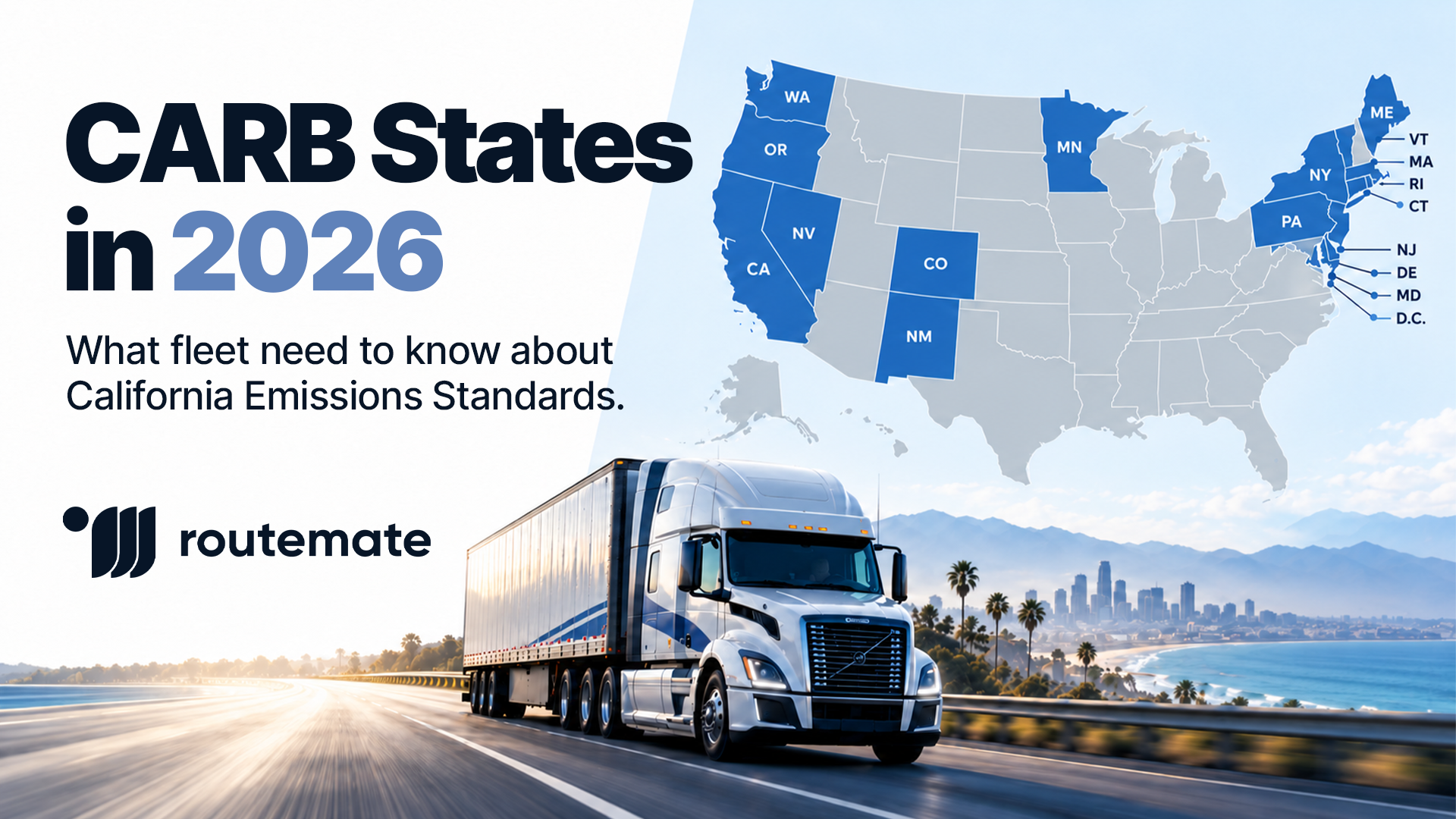
This guide covers who must comply, the core CARB requirements, how often you need to test, what the 2026 EPA ruling means for fleets based in other states, and how to build a workflow that keeps every vehicle on schedule.
What Is Clean Truck Check?
Clean Truck Check is the California Air Resources Board’s Heavy-Duty Inspection and Maintenance (HD I/M) program.
It requires owners of most heavy-duty vehicles operating in California to report them to CARB, pay an annual fee, and pass regular emissions tests showing that their emissions controls work properly.
The program comes from Senate Bill 210, which also created the annual fee that pays for it. Its purpose is to cut air pollution from heavy-duty vehicles by ensuring their emissions control equipment is operating properly. That’s a different job than setting emission standards for new engines, which CARB handles through separate rules.
The rules rolled out in phases, with vehicle reporting and fee payments starting in October 2023. Periodic emissions testing took effect on October 1, 2024, and the first compliance deadlines landed on January 1, 2025.
Which Vehicles Need to Comply With CARB’s Inspection Rules?
CARB’s heavy-duty inspection program applies to almost all non-gasoline vehicles with a gross vehicle weight rating (GVWR) over 14,000 pounds that operate on California’s public roads.
That includes diesel and alternative-fuel trucks, buses, and motorhomes, and it covers vehicles registered in other states and countries, not only California.
The scope covers nearly every non-gasoline heavy-duty vehicle over 14,000 pounds running in the state. Where a vehicle is plated doesn’t change that. According to CARB’s program page, a Texas-based tractor running a regular lane into Los Angeles has the same CARB requirements as one registered in Fresno.
Common exemptions
The list of exemptions is shorter than many fleets expect. The main ones are:
- Zero-emission vehicles
- Vehicles registered as Planned Non-Operation (PNO) with the DMV, plus strictly off-road vehicles that don’t need license plates
- New vehicles with engines certified to CARB’s optional low-NOx standard, but only during the program’s first four years
One detail catches many fleets off guard. There’s no low-use exemption, so a vehicle that only logs a few hundred miles in California each year still has to comply.
The five-day pass
Vehicles that only enter California on rare occasions can use a Five-Day Pass. Each one can get one pass per calendar year, and only if it has no open enforcement actions. The pass doesn’t make the vehicle compliant, and the driver needs to keep it in the cab while operating in the state.
What Are the Clean Truck Check Requirements?
Every covered vehicle has the same three obligations: reporting, an annual fee, and periodic emissions testing. A vehicle only counts as CARB compliant when all three are done for its current deadline.
1. Report every vehicle in CTC-VIS
Your fleet needs an account in CTC-VIS, CARB’s online reporting system, with every covered vehicle listed by VIN. Under CARB’s database reporting requirements, owners attest that the list is complete and must update it within 30 days of any fleet change, which matters whenever you buy, sell, or swap units.
2. Pay the annual compliance fee
The fee is $32.13 per vehicle in 2026, up from $31.18 in 2025. For deadlines on or after January 1, 2027, it rises to $33.12 per vehicle, since the fee follows California’s consumer price index and CARB posts each year’s update by July 1.
Payment timing matters more than the amount. Card payments process the same day but carry a 2.99% fee, while bank payments are free but take five business days, so paying by bank close to a deadline can leave a vehicle out of compliance for most of a week.
3. Pass an emissions test
Every vehicle needs to pass an emissions test for each compliance deadline. The test type depends on the engine, and the next section explains how each one works.
How your compliance deadlines are set
Deadlines depend on where the vehicle is registered. California-registered vehicles follow their DMV registration expiration date and then repeat every six months. Vehicles registered elsewhere, along with DMV-exempt vehicles, follow the last digit of the VIN, and each unit’s dates show up in its CTC-VIS account.
How Are Clean Truck Check Tests Done?
A credentialed tester performs CARB emissions tests for heavy-duty vehicles, and the method depends on the engine. Newer vehicles get a scan of their onboard diagnostic (OBD) data, while older vehicles get a smoke opacity test and a visual inspection. CARB also screens vehicles at the roadside between scheduled tests.
Here’s which test applies to which vehicle, according to CARB’s testing guidance:
| Vehicle type | Engine model years | Test required |
| OBD-equipped diesel | 2013 and newer | OBD scan with a CARB-certified device |
| OBD-equipped alternative fuel | 2018 and newer | OBD scan with a CARB-certified device |
| Non-OBD diesel | 2012 and older | Smoke opacity test plus visual inspection |
| Non-OBD alternative fuel | 2017 and older | Visual inspection only |
OBD testing
Most modern heavy-duty vehicles use OBD testing. The tester connects a certified device to the vehicle’s diagnostic port and pulls the emissions-related data CARB requires, including any active trouble codes.
An active check engine light or emissions-related trouble code means an automatic fail. If the code is permanent, the vehicle needs at least 15 warm-up cycles without the code returning before it can pass, which is why a repair made the week of a deadline often isn’t enough.
OBD tests don’t have to happen at a shop. CARB keeps a list of OBD test devices that hold CARB certification, and some let fleets run tests in their own yard or remotely, saving a trip for every vehicle on every deadline.
Smoke opacity and visual inspection
Older diesel vehicles without OBD get a smoke opacity test, which measures how much light the exhaust blocks, along with a visual inspection of emissions control equipment.
Older non-OBD alternative-fuel vehicles only need the visual inspection, since the opacity test is designed for diesel exhaust.
Who performs the test and submits results
A CARB-credentialed tester has to perform every test and submit the results directly to CARB, so you don’t upload anything yourself. Passing results can go in up to 90 days before the deadline. Fleets can hire a credentialed tester or train someone on their own team to become one.
Roadside emissions screening
Scheduled tests aren’t the only way CARB checks vehicles. The agency also uses roadside emissions monitoring, license plate readers, and CHP field inspections to spot possible high emitters. A vehicle flagged this way gets a Notice to Submit to Testing, which starts its own short deadline (covered in the section on missed deadlines below).
A testing change happening right now
Heavy-duty manufacturers are switching to a newer OBD communication protocol called SAE J1979-2, starting with 2027 model year engines. Some Volvo and Mack engines switched early, beginning with the 2024 model year.
Until certified tools were available, CARB treated these vehicles as meeting the testing requirement. That grace period is ending: starting in October 2026, J1979-2 vehicles with deadlines on or after January 1, 2027 must pass with certified tools. If you run newer Volvo or Mack units, confirm now that your tester’s device supports J1979-2.
How Often Do Vehicles Need an Emissions Test?
Most heavy-duty vehicles need to pass a CARB emissions test twice a year through most of 2027. Starting in October 2027, OBD-equipped vehicles (2013 and newer diesel engines, 2018 and newer alternative-fuel engines) move to four tests a year. Agricultural vehicles and California-registered motorhomes test once a year.
The semi-annual schedule applies in 2025 and 2026 for non-agricultural vehicles. CARB then moves OBD-equipped vehicles to quarterly testing in October 2027, while agricultural vehicles and certain motorhomes stay on an annual schedule.
The quarterly shift doubles the workload for most fleets. A fleet with 40 OBD-equipped vehicles goes from 80 tests a year to 160, and each one needs scheduling, a credentialed tester, and a clean vehicle on test day.
That extra volume is why the testing method matters. Fleets still sending every vehicle to a shop may want to look at in-yard or remote OBD options before the quarterly schedule starts.
Does the Program Still Apply to Out-of-State Fleets After the EPA Ruling?
According to CARB. EPA’s 2026 ruling means the program is federally enforceable only for California-registered vehicles, but CARB says it still applies under state law to every covered vehicle operating in California, including out-of-state units, which must report, pay the fee, and pass tests.
In February 2026, EPA published a final rule that partly approved and partly rejected California’s plan. The approval only covers vehicles registered in California, a point now written into federal regulations. EPA rejected the rest, pointing to concerns about California regulating interstate commerce.
CARB says the ruling changes how the state counts emissions cuts toward federal air quality goals, not whether it can enforce the rules inside its borders. Its program page still lists vehicles registered elsewhere as subject to all three requirements, and industry analysis of the split suggests fleets should plan around that state-level reality.
What this means for brokers, shippers, and gate checks
Proof requests aren’t going away. CARB’s guidance for freight contractors and brokers bases compliance on the VIN and accepts either a vehicle compliance certificate or an affirmation of fleetwide compliance. Those records have to be kept for five years and produced within 72 hours if CARB asks.
Seaports and intermodal railyards also must check that vehicles are compliant at the gate. The legal picture could still shift through court challenges, so if California makes up a large share of your freight, it’s worth having a transportation attorney review your plan.
What Happens If You Miss a Testing Deadline
The biggest risk for California-registered vehicles is a DMV registration hold. CARB places these holds automatically, and a vehicle that can’t renew its registration can’t legally run.
If roadside monitoring flags one of your units, you’ll get a Notice to Submit to Testing. You then have 30 calendar days to submit a passing test, regardless of your regular deadline.
Noncompliance can also cost you freight. Ports and railyards can turn away vehicles, and brokers required to check compliance may pass on a unit they can’t verify.
On top of that, CARB can pursue civil penalties through its enforcement program. The Five-Day Pass won’t get a vehicle out of trouble either, since it can’t be used while enforcement actions are open.
How to Build a Compliance Workflow Before Quarterly Testing Starts
Fleets that handle these rules well treat them as part of everyday operations, not a separate chore. Here’s how to set that up before October 2027 doubles the volume.
Put every deadline in one place
Pull each VIN’s test and fee dates out of CTC-VIS and into the same calendar your team uses for other recurring compliance work, from ELD compliance to other CARB regulations. When every deadline lives in one view, it’s much easier to spot a crowded month before it arrives.
Test early in the 90-day window
Aim to test as soon as the 90-day window opens. If a vehicle fails, you’ll have weeks to repair it, clear the code, and complete the 15 warm-up cycles that a permanent fault requires.
Tie testing to preventive maintenance
Most failed tests trace back to a fault code, so the best time to test is right after a service visit. Line up test dates with your preventive maintenance schedule, and use real-time alerts so you know about vehicle issues when they happen, not on test day.
Keep proof ready by VIN
Brokers, shippers, and terminals will ask for certificates, and CARB can ask for five years of records. Keeping certificates, test results, and repair history together in centralized fleet reports makes those requests easy to answer.
Choose your testing method for 2027 now
Decide whether you’ll keep using outside testers, train your own staff, or use a certified remote device. Becoming a credentialed tester means taking CARB’s training course, passing the exam, and getting approved equipment, which takes time to set up.
Conclusion
CARB’s inspection program comes down to three things. If a non-gasoline vehicle over 14,000 pounds runs in California, it’s almost certainly covered, wherever it’s plated. Every unit needs reporting, a paid fee, and a passing test for every deadline. And the workload is growing, with quarterly testing for OBD-equipped vehicles in October 2027 and a $33.12 fee starting in January.
Staying CARB compliant isn’t hard once it’s built into your routine. Fleets that track deadlines in one place, test early, and connect testing to maintenance tend to pass on schedule and keep their trucks earning, while doing their part to cut air pollution across California.